
Distance Plays a Role Pointillism and human relationships At the Art Institute of Chicago, you can find a woman in a violet bustle dress. She stands like a mannequin; draping from her left hand is a leash on a capuchin monkey, and balanced on her right shoulder is a petite parasol. Sprawled around her, people relax under the afternoon sun. From up close, you won’t recognize her but only see marbles of color. She is a lady in A Sunday Afternoon on the Island of La Grande Jatte by Georges Seurat. This painting is a textbook example of pointillism: a technique of dotting the canvas with patterns to form an image. In proximity [1], the viewer only sees a sea of distinct, meaningless dots, but at a distance, they see waves of lines and shades blending to create a larger image. Holding your little sibling or nephew’s hand, visit the Art Institute of Chicago. Together, you can look at a pointillism painting while you proudly explain your educated perspective to the kid gasping and giggling next to you. Wow, that’s fun! Yes, it’s fun, but pointillism is much more than just an interesting neo-impressionism movement from the past. The technique itself has a resemblance to human conflict and reconciliation [2]. In both pointillism and human relationships, distance plays a similar role. Inspecting a single dot from up close gives you little more than confusion. In relationships, when you’re assailed by the emotional whirlpool right after a fight, nothing makes sense, including yourself. You may craft a narrative for an illusion of awareness, a story riddled with holes. In hindsight [3], when you can separate yourself from the hurtful feelings, when you have regained your distant composure, you can see yourself and the other person better. Each dot is madness, but together they form a larger image of meaning. If closeness is a blindfold, people’s lack of self-awareness in conflicts is inevitable [4]. Our own faults that are always so obvious to others elude [5] us. In extreme proximity, we see only red specks of rage, neither arch nor shape. Oblivion may be appalling when seen in others, but remember that they, too, need some time to distance themselves from the fury. Discussion Questions Q1 In your own words, please briefly summarize the article. Q2 What part of the reading resonated with you most? Q3 Have you ever seen a painting made with pointillism? What was your impression of it? Q4 Why do you think Seurat used tiny dots to create a complete picture? Q5 Can you think of a time when you needed distance from a problem to understand it better? Q6 Why is it hard to see our own mistakes during a conflict? Q7 What helps you calm down after an argument with someone close to you? Q8 The article says, “Each dot is madness, but together they form a larger image of meaning.” What do you think this means? Q9 Do you agree that emotions can “blind” us in the moment? Q10 How do art and human emotions relate to each other in your opinion? Q11 If you have a question or questions that you'd like to discuss during your class, please write them down. Expressions proximity nearness in space, time, or relationship 例句 1 The proximity of the hotel to the beach makes it very popular. 例句 2 The baby was comforted by the proximity of her mother. reconciliation the act of restoring friendly relations or resolving a conflict 例句 1 Their reconciliation after the argument was heartwarming. 例句 2 The movie ends with a reconciliation between the father and son. hindsight understanding of a situation or event only after it has happened 例句 1 In hindsight, I realized I should have taken that job offer. 例句 2 With the benefit of hindsight, the decision seems unwise. inevitable certain to happen; unavoidable 例句 1 Death is an inevitable part of life. 例句 2 With so much rain, flooding was inevitable. elude to escape from or avoid something, often cleverly or skillfully 例句 1 The suspect managed to elude the police for weeks. 例句 2 The meaning of the poem eludes me. |
| *本教材是專爲使用Ringle學習英文的學員設計。 |
At the Art Institute of Chicago, you can find a woman in a violet bustle dress. She stands like a mannequin; draping from her left hand is a leash on a capuchin monkey, and balanced on her right shoulder is a petite parasol. Sprawled around her, people relax under the afternoon sun.
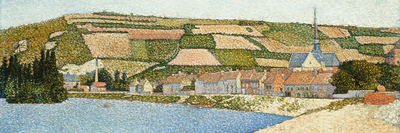
From up close, you won’t recognize her but only see marbles of color. She is a lady in A Sunday Afternoon on the Island of La Grande Jatte by Georges Seurat. This painting is a textbook example of pointillism: a technique of dotting the canvas with patterns to form an image. In proximity [1], the viewer only sees a sea of distinct, meaningless dots, but at a distance, they see waves of lines and shades blending to create a larger image.
Holding your little sibling or nephew’s hand, visit the Art Institute of Chicago. Together, you can look at a pointillism painting while you proudly explain your educated perspective to the kid gasping and giggling next to you. Wow, that’s fun! Yes, it’s fun, but pointillism is much more than just an interesting neo-impressionism movement from the past. The technique itself has a resemblance to human conflict and reconciliation [2]. In both pointillism and human relationships, distance plays a similar role.
Inspecting a single dot from up close gives you little more than confusion. In relationships, when you’re assailed by the emotional whirlpool right after a fight, nothing makes sense, including yourself. You may craft a narrative for an illusion of awareness, a story riddled with holes. In hindsight [3], when you can separate yourself from the hurtful feelings, when you have regained your distant composure, you can see yourself and the other person better. Each dot is madness, but together they form a larger image of meaning.
If closeness is a blindfold, people’s lack of self-awareness in conflicts is inevitable [4]. Our own faults that are always so obvious to others elude [5] us. In extreme proximity, we see only red specks of rage, neither arch nor shape. Oblivion may be appalling when seen in others, but remember that they, too, need some time to distance themselves from the fury.