
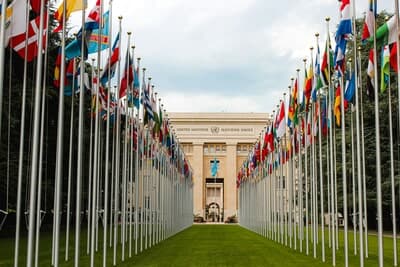
A brief history
The United Nations, headquartered in New York, is arguably one of the most influential international organizations. Established in 1945, the organization celebrated its 75th anniversary in 2020; it has 193 member states as of 2021 — close to exhausting the list of all independent nations in the world. Yet, the conditions that had led to its foundation were not as glorious.
In the year World War II ended, when the memories of the atomic bombing and Hitler’s extermination camps were still fresh, the UN was founded with a mission to maintain international peace, secure human rights, and promote better living conditions. “Better living conditions” — at the time, people could easily witness abject [1] poverty and discrimination in parts of the world.
The UN wanted higher living standards, just above the bare minimum. Borrowing the words of the second UN secretary-general, it “was created not to lead mankind but to save humanity from hell.” Yet, upon its establishment, the UN started a steep decline as the Cold War (the rivalry between the Soviet Union and the United States) unfolded.
Whether the UN was instrumental in preventing a nuclear war between the two superpowers divides historians. Regardless, the organization did play an essential role in helping countries decolonize and stabilize after World War II. Notably, efforts of this kind extended to the Korean Peninsula. The UN Temporary Commission on Korea was established in 1947 to support the birth of the Republic of Korea.
In June 1950, when the Korean War broke out, the United Nations Command was launched to help restore peace and security. The UN subsequently supported the post-war reconstruction efforts of the Republic of Korea through the United Nations Korean Reconstruction Agency, which spent $127 million (the equivalent of $924 million today) to undertake over 260 projects until its closure in 1958.
Today, the UN’s major responsibilities include fostering harmonious relationships between its member states, providing food and medical relief in emergencies, and undertaking humanitarian initiatives to support those deprived of basic human rights. The organization has six main bodies to execute these responsibilities: the General Assembly, the Security Council, the Economic and Social Council, the Trusteeship Council, the International Court of Justice, and the Secretariat. (The Trusteeship Council suspended operation in 1994, following the independence of Palau, the last remaining UN trust territory.)
Accomplishments
We don’t know if the UN indeed prevented another World War since counterfactual [2] outcomes are uncertain. (In other words, we don’t know what would have happened had it not been for the UN’s existence.) But its peacekeeping efforts, including mitigating various regional and national conflicts, led to a Nobel Peace Prize in 1998. UN peacekeepers are cited for playing a role in ending the decade-long war in Sierra Leone. The organization also influenced several countries, such as Kazakhstan after the collapse of the Soviet Union, to abandon the pursuit of nuclear weapons.
Outside the immediate domain of peace, human rights have been the cross-cutting theme of the UN’s policies and initiatives. The Universal Declaration of Human rights was adopted in 1948. Currently, a plethora [3] of sub-organizations and programs define and support human rights, including the rights to sustainable development and food, labor rights, gender equality, the rights of children, indigenous people, and the disabled.
The UN's efforts to alleviate famine in the world since the 20th century have been particularly successful. As a case in point, the United Nations World Food Program (the 2020 Nobel Peace Prize Laureate) provides assistance to 115 million people in 84 countries in the form of nutrition support programs and cash distributions.
Criticisms
Some exalt the UN as the beacon of hope, while others criticize it for its numbing bureaucracy and institutional cover-ups of corruption. In June 2021, Daniel Kipfer Fasciati, the UN’s chief advocate for “alleged [4] terrorists,” resigned, citing “red tape” (bureaucratic inefficiency) issues.
Furthermore, it is often pointed out that the UN’s goals and objectives are abstract and utopian. In 2021, The Economist once called the Sustainable Development Goals (the UN’s blueprint for achieving a better future) “worse than useless.” These goals employ broad and ambitious language, such as “end all forms of discrimination against all women and girls everywhere,” and “achieve full and productive employment and decent work for all women and men.” In fact, the vagueness of the language used in UN documents is often highlighted at many academic and organizational gatherings.
Administrative bloat is part of the problem as well. Multiple agencies within the UN have overlapping goals. Unfortunately, instead of establishing a collaborative framework, they compete for limited resources. This problem multiplies with the size of the organization. For example, more than 30 UN agencies and programs have a stake in environmental management.
Others point out the unfair distribution of power within the UN system. The Security Council, one of the principal bodies of the UN, consists of five permanent members chosen based on their importance after World War II. Only those five countries — China, France, Russian Federation, the United Kingdom, and the United States — have the power to veto any proposed resolution. Given the possibility of any one of these countries abusing power to pursue its own interests, critics argue that there should be no permanent member of the UN Security Council.
A funding conundrum
Despite its ambitious goals, the UN is heavily underfunded. Most of the funding relies on officials “begging” governments year after year. A report stated that one-third of UN operations in 60 countries had a budget of less than $2 million per agency, which meant that they could do little more than to afford the cost of running the office. The funding of the UN has progressively been decreasing, especially due to countries not paying their full dues to the UN. In 2019, the UN reported being $2 billion short on just its peacekeeping funds. This leads to the classic chicken or the egg problem: is the UN unsuccessful because of the underfunding, or is it underfunded because it is unsuccessful?
Every organization has its flaws, and the UN is no exception. While many agree that the UN continues to play a critical role in securing peace and prosperity [5] in the world, fundamental structural changes may be long overdue.