
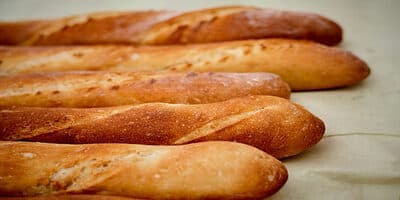
Walk into any French neighborhood early in the morning and you will see the same routine [1]. People stop by the local boulangerie, hand over a coin, and walk out with a warm baguette under one arm. The tip is often broken off and eaten soon after. A freshly baked baguette usually costs around a euro. Buying good bread is just part of the day, like grabbing a coffee. A fashionable bakery in the 2nd arrondissement might charge two euros for a gilt-stamped [2] stick. But the classic baguette averages just over a euro in bakeries, and supermarket versions can dip below 60 cents.
Cheap does not mean careless. A good French baguette is nothing like the dry, oddly soggy [3] imitations sold elsewhere, including in the US. What protects the real thing is the 1993 Bread Decree (Le Décret du Pain). Its Article 2 sets strict rules for any bread sold as pain de tradition française, such as the baguette tradition. This bread may contain no additives [4]. It must be made from only four ingredients: wheat flour of a specified purity, water, salt, and a leavening agent. The dough cannot be frozen at any stage. The law protects the phrase pain de tradition française, not the plain word "baguette." That is why the "tradition" label matters so much.
But why would a government write bread into law? In France, bread is not just food. It is part of national identity, along with cheese and wine. In Cuisine and Culture, Linda Civitello notes that bread was once treated as a public service [5]. It was so essential that the police oversaw its production. Some historians argue that bread shortages helped fuel the French Revolution. That idea echoes in the famous line "Let them eat cake." The quote, actually closer to "let them eat brioche," is almost certainly misattributed [6]. It appears in Rousseau's Confessions, written when Marie Antoinette was still a child in Austria. Whether or not she said it, the story stuck. It captured a real fear: a ruler who does not care whether the people can afford bread.
This is where the French approach gets interesting. Behind the law is a simple idea. Good bread is a necessity [7] everyone should be able to afford, not a luxury sorted by price. The Bread Decree enforces that belief. It keeps quality high while the market keeps prices low. As a result, an ordinary worker and a wealthy banker can eat the same loaf.
Critics might call this unnecessary state interference [8]. Supporters would say some things, like decent [9] bread, are too important to leave to the market. Younger French people now eat less bread than their grandparents did. But with more bakeries than convenience stores, demand for the real thing stays strong.