
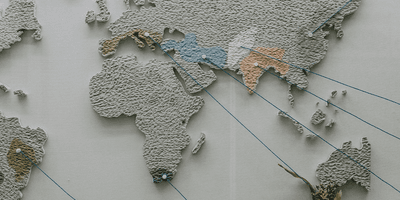
For nearly three decades, the world believed in a powerful idea: that trade would bind nations together so tightly that war would become unthinkable. In the 1990s, after the Cold War ended, this belief took center stage. Borders opened, tariffs fell, and supply chains stretched across continents. China joined the World Trade Organization in 2001. The European Union expanded eastward. Goods, capital, and ideas flowed more freely than at any point in modern history. Economists called it the golden age of globalization, and many assumed it would last forever.
The first cracks appeared quietly. The 2008 financial crisis shook faith in unregulated markets. The Brexit vote in 2016 signaled that ordinary citizens in wealthy countries no longer believed globalization was working for them. Around the same time, the United States and China began their first round of tariff battles, and the word "decoupling" entered the diplomatic vocabulary. Few realized then how prophetic [1] that word would become.
The COVID-19 pandemic was a turning point. When ports closed and factories stopped, the world discovered just how fragile its supply chains had become. Nations that had outsourced the production of masks, medicines, and microchips suddenly felt exposed. Efficiency, once the highest economic virtue, gave way to a new priority: security.
Then came 2022. Russia's invasion of Ukraine weaponized energy markets overnight. The U.S.–China rivalry escalated into a full-scale technology contest, with semiconductors at its center. New terms appeared in policy documents around the world — friend-shoring, de-risking, economic statecraft. Trade was no longer just trade. It had become a tool of power, and sometimes, a substitute for war.
But the most striking development was yet to come. By 2025 and 2026, even the transatlantic alliance — the cornerstone of the postwar order — was under visible strain. Washington's "Liberation Day" tariffs hit European goods. The Greenland crisis of January 2026 saw the United States threaten its own NATO allies with punitive [2] tariffs, prompting Brussels to consider, for the first time, deploying [3] its Anti-Coercion Instrument — a tool originally designed for hostile [4] powers — against the United States itself. Europe accelerated its pursuit of strategic autonomy, signed a long-stalled trade pact with Mercosur — the South American bloc led by Brazil and Argentina —, and began rethinking dependencies it once took for granted.
The picture today is not a simple split between two camps, but a more tangled landscape. Investment flows along shifting geopolitical lines rather than economic logic alone. Allies impose tariffs on allies. Rivals continue to trade. Companies build parallel supply chains while quietly hedging against multiple possible futures.
Yet globalization has not disappeared. Global trade volumes remain near historic highs. Travel, data, and ideas continue to cross borders. What has ended is not connection itself, but the belief that connection was politically neutral. The lesson of recent years is sobering: economic interdependence does not guarantee peace, shared markets do not erase rival interests, and even the closest alliances are no longer immune to economic coercion [5].
The question now is not whether globalization is dead, but what shape it will take next. Will the world fragment into competing spheres? Will a new equilibrium emerge between openness and security? Or are we entering a longer period of uncertainty, where each crisis quietly rewrites the rules?