
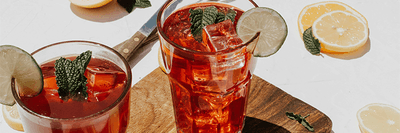
Fermented foods have a long and rich culinary history: from cheese to kimchi, their popularity knows no bounds. Kombucha, a delicious fermented drink, is also no exception.
Believed to have originated in China in 220 BC, this fermented tea has since made its way across the world, giving rise to variations in flavor to suit all different tastes. Typically made from black or green tea and sugar, kombucha comes into existence after SCOBY (a symbiotic [1] colony of bacteria and yeast) is added to the mixture of tea and sugar and allowed to ferment for weeks to months. Indeed the process is so basic that some even brew their own kombucha at home, although as a general rule, we do not formally advise anyone to try this on their own.
Once the kombucha ferments, it takes on a fizzy [2] form, whose flavor profile can be described as somewhat similar to that of beer. However, it tends to be sweeter or more vinegary depending on the original sugar content of the batch. Kombucha in its commercial form contains less than 0.5% alcohol, but homebrews can have alcohol content as high as 3%. Regardless of its origins, in most cases, kombucha isn’t classified as an alcoholic beverage.
Kombucha is, additionally, well-known within the health-food community as a superfood. Believers in the power of kombucha have made claims about it treating digestive issues, helping with blood sugar as an alternative to soda, and even curing incurable diseases. Of course, these claims are not proven, and although some of them have a factual basis (kombucha is indeed a probiotic [3], which helps with gut health), other claims (such as its ability to help diseases untreatable by medical science) are not well-founded.
Regardless of whether you believe in the supernatural powers of this fizzy drink, for those who enjoy the flavors of kombucha, it can be a healthy alternative to soda. But beware that certain kombucha brands are still rather high in sugar; it’s always important to check out the nutrition facts when making any dietary decision. Ultimately, I think of kombucha as a fun, sparkling elixir [4] that also provides a boost of caffeine.