
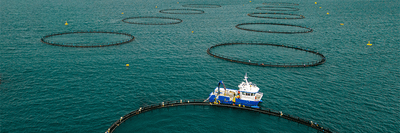
As the world’s third-largest farmed salmon producer, Scotland’s fish farming industry has created 12,000 jobs and annually contributes almost a billion pounds to the economy. However, despite the rapid success and expansion of commercial aquaculture (the production of aquatic organisms under controlled conditions), it is undeniable that it has become one of the most controversial industries currently operating at scale, with the discussions over its future described as “the most bitter and stubborn [1] face-offs [2] over industrial development ever witnessed.” Since tight industry standards and regulations in Scotland mean that companies can’t be run by ocean cowboys wreaking havoc [3] purely in the name of profit, it is interesting to consider why the choice to eat farmed fish remains so divisive.
The dilemma is primarily due to an insurmountable [4] divide in how we view the future of the environment. The anthropogenic influences on the environment are well-known to all of us: declining populations from overfishing, climate change as a consequence of greenhouse gas emissions, and habitat loss from the exploitation of land and ocean resources, to name just a few. However, attitudes toward potential solutions to these problems can be divided into two camps, “Environmental Modernists” and “Environmentalists.” Environmental Modernists are realistic optimists and believe that humans will find the answer to the world’s problems through technology, i.e., that we will be able to engineer ourselves out of the trouble that we’ve caused, and therefore, adopting new technologies is our best option. On the other hand, Environmentalists are realistic pessimists and believe that technology doesn’t have the answer we are so desperately searching for; our only course of action is to try and ensure that the environment functions as it would have if humans had never intervened. In short: is it better to engineer a solution to declining fish stocks or focus our attention on restoring without artificial replacement?
The distinction between Environmentalist and Environmental Modernist becomes particularly important when we consider that the number of salmon caught in Scotland this year was at a record low of around 35,000. The Environmental Modernist argues that we must continue to reduce the fishing pressure and try to produce farmed salmon as a commercial alternative. However, the Environmentalist argues that persistent environmental problems from commercial aquaculture potentially threaten wild stocks, thus not addressing the problem it aims to fix. Who’s right? You’ll need to examine your values to find out.
While a controversial industry for many years, aquaculture has been redeemed in the eyes of many—including my own—due to the Blue Revolution (the intense growth of global aquaculture production), and aquaculture’s self-proclaimed capacity for feeding the world. In most areas of the world, we have reached our capacity for terrestrial [5] agriculture and wild-caught fish due to worldwide declines in fish stocks, soil erosion, water shortage, and the proliferation of disease, all of which have contributed to continued global food shortages. With a global population expected to reach 8 billion by the end of the year, the need for sustainable and healthy protein continues to be a significant concern.
The lower food conversion ratios in aquaculture are well-known to many and make it economically attractive to farm fish (seven kilos of feed is required to produce one kilo of beef, while just over one kilo of feed is required to produce one kilo of salmon). It is hard to argue, then, that fish farming wouldn’t be the way to solve global food problems. However, commercial aquaculture in Scotland isn’t trying to solve these problems. The latest reports show that while demand for seafood is growing, the change in demand is greatest in developed countries. Despite the farmed salmon industry’s years of development, it is still a luxury food item in the UK. Furthermore, of the 1 billion dollar investment into China’s aquaculture, most farms are dedicated to luxury seafood projects, not affordable protein sources. Perhaps we should all reflect on our consumption habits and think, are we buying something because we need it or because it is freely available? If we are concerned about the Blue Revolution, we need to focus on the areas that require our assistance, stop paying lip service to the “feeding the world” tagline and put legitimate plans in place for distributing seafood to malnourished populations.