
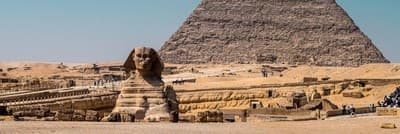
The second stop on our grand tour of world history is just a few thousand years after our adventures in prehistory. By now, humans have settled into cities and towns and created advanced farming techniques. Here in the year 2,500 B.C.E., in a time known as “Age of the Pyramids,” the Egyptian kings of the great Fourth Dynasty have built massive tombs and monuments in their honor. Ruling from the great city of Memphis along the Nile, they are working hard to create one of the world’s most famous cultures.
We can’t spend time in Egypt without visiting the Great Pyramid of Giza, also known to locals as Khufu’s Tomb. This is the largest and oldest of all the great Egyptian pyramids and is considered one of the Seven Wonders of the Ancient World. Following the King’s death and the completion of his tomb, this pyramid will be the largest human-made structure in the world for nearly 4,000 years. The large outside made of solid rock disguises [1] three major chambers hidden within the tomb for the King and his family members. Buried below the pyramid are goods for the afterlife, including several boats, gold, pottery, and food. Modern scientists aren’t quite sure what tools were used to build the pyramids, given their complexity and the heaviness of the stones. Additionally, the pyramid is closely aligned to the four geographic directions, which required the use of advanced physics and astronomical calculations, adding to the fame of the site.
Not all amazing Egyptian crafts were buried with kings, and in our time in Ancient Egypt, we must be sure to travel to the great markets along the Nile. As we walk through the market, the smells of perfume and incense fill the air. We stop at a food stall and purchase warm flatbread that has been grilled in an oven and seasoned with cilantro and butter. Sipping on pomegranate juice and strolling through the bustling streets, we will see hundreds of potters and artists selling their wares. Cats are considered powerful and adjacent to the gods, so many of these urns feature cat heads. Lions and other great animals are also commonly seen as examples of strength.
Decorating vases, papyrus scrolls, and the inside of the pyramids is the ancient Egyptian written language known as hieroglyphics. Similar to modern Chinese, Ancient Egyptians wrote using a “logogram” system, wherein each symbol represents a sound, word or meaning. Vast walls of writing feature almost infinite [2] combinations of characters and meanings. Scholars spend their entire lifetimes learning just to write inside these tombs and vases, and future scholars will spend hundreds of years attempting to decipher their meanings.
Ancient Egypt may have a great cultural wealth, but that does not mean that the people are poor by any means. As we continue our journey through the city and board a boat on which we can tour the Nile, nearly everybody we see has decorated themselves with rich makeup and gold. Men and women alike use these fashion symbols to showcase their wealth and beauty to the world. One particularly unique custom is putting scented animal fat on the top of your head, allowing the warm and scented oil to melt and perfume your body in the hot desert sun. As strange as this may be, this early version of perfume leads the city to smell strangely beautiful as we cruise down the Nile.
A final and spooky destination cannot be missed as we approach the legendary Valley of the Kings. King Tutankhamun, also known as King Tut, is one of the most famous Egyptian Kings, not only for his building of magnificent tombs but the curse that he left upon explorers years later. King Tut ascended to the Egyptian throne at a very young age, likely only 8 or 9 years old. Though he died just 10 years later, he built a great amount of wealth during his time on earth. Years later, his tomb was opened by British explorer Howard Carter, against the advice of locals. A number of mysterious deaths associated with that team have led many to believe that those who enter Tut’s tomb are doomed to die a mysterious and painful death.
One particularly famous story was the demise of one explorer’s pet—shortly after opening the tomb, Egyptologist George Herbert of Carnavon arrived at his home to find his pet bird eaten by a cobra, a famous symbol of Ancient Egypt. Following the deaths of four more explorers, international media ran many stories speculating upon the curse, yet daring adventurers continued to explore the area. This curse came to inspire the legendary [3] film The Mummy. Despite these terrifying curses, Ancient Egypt is a rich and mysterious land that is sure to captivate audiences for thousands of years to come.