
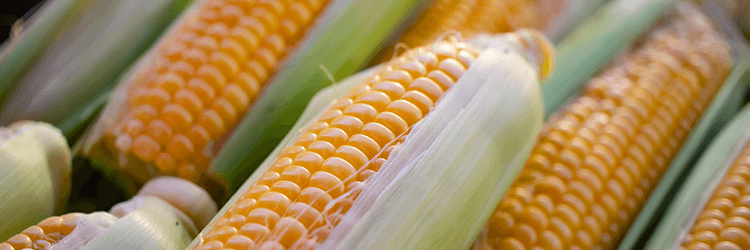
Although corn on the cob is not the most common food on our lunch plate, our entire food system relies on this single crop.
Corn, a crop native to Central America, is the most widely-grown crop in the world. The world’s largest corn grower is the U.S., responsible for almost one-third of its yearly production, followed by China and Brazil. In 2021, the global production of corn was over 1.1 billion tons.
But who is eating all this corn? In countries besides Mexico and Brazil, where corn has been a staple [1] for centuries before the Columbian exchange, wheat-based bread and rice seem to be more popular than the sweet, yellow kernels. In fact, human consumption of fresh corn makes up less than 1% of all the corn produced around the world. Other, more common forms of consumption include corn oil, flour, starch, and syrup. The infamous [2] high fructose corn syrup is another major corn product, which has gained popularity among food manufacturers due to its low cost and sweetness stronger than that of regular corn syrup.
In addition to supplying a wide array of byproducts [3] for human consumption, maize is also the number one crop for livestock feed; it is used to feed most farm animals and poultry, including chicken and cattle. This way, humans consume tons of corn indirectly—let’s take Korea’s famous BBQ chicken as an example. By eating a fried chicken coated with a sweet, spicy glaze, you are most likely eating a chicken that has been fed on corn, breaded in corn starch, deep fried in corn oil, and finally, coated with a corn-syrup-heavy sauce.
In the past decade, the demand for corn grew alongside meat consumption. More farmers, in response to this trend, converted their farmland to raise corn. This movement gained momentum when researchers found how to make ethanol and other biofuels out of corn—which was now the most versatile [4] and easy-to-grow crop.
However, with more corn came more problems. Corn farming is resource intensive, meaning it requires a lot of soil and water, quickly depleting [5] nutrients from the ground. For sustainable corn farming, one ought to plant a limited number of bushels per acre, and rotate crops to restore the soil’s nutritional balance. However, the market was too impatient for this sustainable method to spread; in the meantime, genetic engineering and highly concentrated fertilizers became prevalent.
These developments have wreaked havoc [6] on the environment and global food security. Not only have strong fertilizers and pesticides degraded the soil, but biodiversity has also taken a hit, as one type of pest or disease could potentially wipe out multiple farms of a single variety of corn. Devoting too much farmland to corn also decreases the supply of other crops, driving up their prices while reducing the diversity of products we enjoy.
Corn has become a power crop, efficiently feeding the world’s animals and fueling the economy. Yet, heavily concentrated corn farming has brought along problems that should be addressed in order to ensure a healthy environment.