
How has your experience at immigration been? Most of the trip, you can get by with limited English, but the counter at immigration is the exception. The officer asks a few questions, and customs adds a few more. Once you know how the questions go, the whole thing usually goes smoothly. Let's walk through it.
Basic questions at passport control
- Officer: What's the purpose of your visit?
- You: I'm here for sightseeing. [1]
- Officer: How long are you staying?
- You: For two weeks. [2]
- Officer: Where will you be staying?
- You: I'm staying at the Hilton in Manhattan. [3]
- Officer: Is this your first time in the US?
- You: Yes, it's my first time. [4]
- Officer: Welcome. Enjoy your trip.
Watch out: Short answers work best, longer replies tend to invite more questions. Have your hotel name and address ready on your phone or on paper before you reach the counter, since Wi-Fi may not work inside the terminal. If you're visiting a friend, know their full name, address, and how long you've known them.
Follow-up questions
- Officer: What do you do for a living?
- You: I'm a software engineer [5].
- Officer: Who are you visiting?
- You: A college friend. She lives in Brooklyn [6].
- Officer: Do you have a return ticket?
- You: Yes, let me show you [7].
- Officer: And you're staying with her the whole time?
- You: Yes, for two weeks. I fly back home on the 15th [8].
- Officer: Alright. Welcome.
Watch out: Follow-up questions don't mean you're in trouble. Answer calmly and specifically, vague answers like "I don't know" or "just visiting" invite more questions. In some cases you may be pulled aside for secondary inspection [9], a longer interview in a separate room.
At customs
- Officer: Anything to declare? Any food?
- You: Just some snacks and instant noodles. [10] All vacuum-sealed.
- Officer: How much cash are you carrying?
- You: About four thousand dollars. [11]
- Officer: Anyone traveling with you?
- You: My wife is with me. [12] She has around three thousand.
- Officer: You're under ten thousand combined, that's fine. Enjoy your stay.
- You: Thank you.
Watch out: Food and cash rules vary by country, but certain foods (meat, fresh fruit, vegetables, seeds) are usually confiscated, and cash above a certain amount has to be declared. Skipping it can mean losing the whole amount plus a fine, so it's safer to check your destination's rules before you fly.
[Cultural Notes]
The officer's face isn't personal.
- Immigration officers are trained to keep a neutral, sometimes stern expression. They're screening hundreds of people a day and reading micro-expressions along the way. Smile if you want, but don't take their flat tone as hostility. Eye contact, short answers, and confidence go a long way.
Fast-track programs are spreading.
- Many airports now also offer self-service kiosks and pre-approved traveler programs. In the US, Global Entry opens a fast lane for pre-approved travelers, and Mobile Passport Control (MPC) is a free app for eligible passport holders. Similar systems exist elsewhere: SmartGate in Australia, ePassport gates in the UK, and various trusted-traveler programs across Asia and Europe.
Detection dogs at baggage claim.
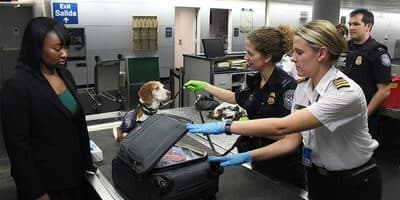
- In many countries, you might see small detection dogs wandering between suitcases near baggage claim. They're trained to sniff out meat, fruit, and plants, and they're very good at it. Even sealed food inside your bag gets found. If one sits down next to you, don't panic. It just means an officer will check your bag.