
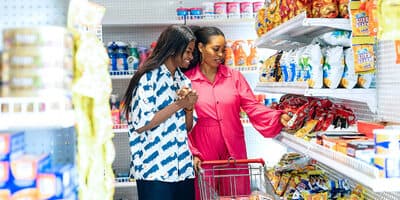
Grocery shopping is one of those things you assume will be easy. You know what you need, you have a list, you push the cart around. Then a friendly cashier asks, "Did you find everything you were looking for?" and you freeze. Or the cashier asks "Do you need a bag?" and follows up with "How many?" and you realize you don't have an answer ready. Or you're standing in front of the herbs, trying to remember whether Americans call it cilantro [1] or coriander.
American grocery stores also have their own culture: rewards cards, self-checkout, coupons, BOGO [2] deals, and produce [3] that you weigh yourself. Once you know the flow, one shopping trip becomes muscle memory [4]. Let's walk through it together.
In the produce section
- You: Excuse me, where can I find the cilantro?
- Staff: Right over here, next to the parsley.
- You: Thanks! Are these apples weighed at the register?
- Staff: Yes, they'll ring it up at checkout.
Watch out: "Cilantro" and "coriander" refer to the same plant, but Americans use "cilantro" for the fresh leaves and "coriander" for the dried seeds. Bunched [5]herbs (cilantro, parsley) and pre-packaged items are usually priced per bunch or per package, so no weighing needed. But loose produce like apples, potatoes, or onions is priced per pound and weighed at checkout. When in doubt, just ask.
Asking for help in the aisle
- You: Hi, do you carry [6] gochujang?
- Staff: Sure, it's in aisle 12, on the top shelf. International foods.
- You: Perfect, thank you.
- Staff: No problem. Let me know if you need anything else.
Watch out: "Do you carry ~?" is the standard way to ask if a store stocks a specific item. "Do you have ~?" also works but is slightly more casual. American grocery aisles are numbered, and staff will usually guide you to a specific aisle. Big Korean or Asian items are often in the "International foods" or "Asian foods" section.
At checkout
- Cashier: Hi, did you find everything you were looking for?
- You: Yes, thanks.
- Cashier: Are you a rewards member?
- You: Not yet. Can I sign up? / No, I'm good. Thanks though.
- Cashier: Sure, just download our app and register with your phone number. You can do it right now if you'd like — I'll wait.
- You: I'll do it now, thanks. / No, I'll sign up later, thanks.
Watch out: Rewards cards are almost entirely digital now. Instead of getting a plastic card, you download the store's app and register with your phone number. At checkout, you either scan the app's barcode or just enter your phone number on the keypad. Digital coupons are "clipped" in the app before you shop, and they automatically apply when you check out. If a cashier asks "Are you a rewards member?" and you're not sure, just say your phone number — it's the fastest way to check.
Bagging, ID, and payment
- Cashier: Do you need a bag today?
- You: Yes, please.
- Cashier: How many?
- You: Two, please.
- Cashier: Got it, that'll be 20 cents for the bags. And I'll need to see your ID for the wine.
- You: Sure, here you go.
- Cashier: Thanks. Your total is $52.03. Debit or credit?
- You: Credit.
- Cashier: You're all set. Have a good one!
- You: You too, thanks!
Watch out: At the register, cashiers usually ask "Do you need a bag?" and then "How many?" You pay 5~12 cents per paper bag, so most locals bring their own reusable bag. ID is required for alcohol (wine, beer, spirits) and for certain cold medicines like Sudafed. A driver's license, passport, or state ID all work. "Credit" doesn't require a PIN and is almost always the safe choice.
[Cultural Notes]
Rewards apps are how you save.
- Most big grocery chains have a free app. Register with your phone number, "clip" digital coupons before shopping, and either scan the app or just enter your phone number at checkout. No plastic card needed. Regular shoppers save 20~30% on certain items.
Paying for bags is a nudge, not a scam.
- 5~25 cents per bag feels odd at first, but the fee is intentional [7] — it pushes you to bring your own. Most locals keep reusable bags in the car. A weekly shopper can spend $25~50 a year on bags without realizing it.
IDs are checked for alcohol and some medicines.
- Cashiers routinely [8] check ID for alcohol and cold medicines like Sudafed — it's the law, not personal judgment. A driver's license, US state ID, or passport all work. Even people who clearly look over 30 get carded.
BOGO is your friend.
- "BOGO" = "Buy One Get One" (often free, sometimes 50% off). Watch for these in weekly ads or in the app. Combine with digital coupons for even bigger savings.
Self-checkout: fast, but the regular lane is practice.
- Self-checkout is great for a handful of items. But if you have loose produce or alcohol, the regular lane often ends up faster. And here's a bonus: choosing the regular lane, even when you're in a hurry, gives you a real chance to use English. Every "Yes, thanks," "How are you today?" and "Have a good one" adds up. A minute of small talk at the register is a small workout your English will thank you for.