
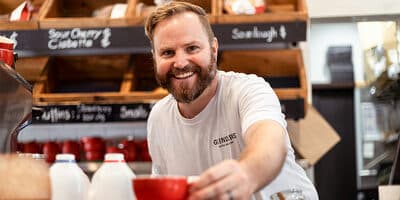
Ordering coffee sounds simple, right? Then you walk into a cafe overseas and hear: "Hi, what can I get started for you?" You freeze [1]. Sure, cafes back home ask questions too. "For here or to go?" "What size?" But at bigger chains in the US, a single coffee order can involve four decisions in a row: size, milk, hot or iced, and any extras. And they'll ask your name, too.
Once you know the flow [2], you'll walk in like a regular.
At the counter
- Barista: Hi, what can I get started for you?
- You: Can I get an iced americano [3], please? Light ice, and make it a decaf.
- Barista: Sure. What size?
- You: A medium, please.
Watch out: At bigger chains, sizes may sound unfamiliar. One well-known chain uses "tall (small), grande (medium), venti (large)." Most other cafes just use "small, medium, large." Adding "light ice" or "decaf" upfront saves everyone time. And "what can I get started for you?" just means "what would you like?"
Customizing
- Barista: Anything else with that?
- You: Could I get an extra shot, please? And oat milk instead of regular [4].
- Barista: Sure. Any room for cream?
- You: No room, thanks.
- Barista: Is that all for you today?
- You: Yes, that's it. Thanks.
Watch out: “Room for cream?" means "Do you want space at the top to add cream or milk yourself?" Say "no room" if you want it full. "Is that all?" and "Anything else?" mean the same thing, so "Yes, that's it, thanks" closes the order politely. Milk alternatives (oat, almond, soy, coconut) are widely available at almost every cafe now.
Giving your name
- Barista: Can I get a name for the order?
- You: It's Jihoon. J-I-H-O-O-N.
- Barista: Got it. That'll be $5.75.
Watch out: Baristas write your name on the cup, so speak slowly and spell if needed. Many Koreans use an easy English nickname (Jay, Sam, Kevin) just for coffee orders. It saves time and avoids the awkward "wait, whose is this?" moment.
Wrapping up
- Barista: For here or to go?
- You: To go, please. Where do I pick it up?
- Barista: Right at the other end of the counter. We'll call your name.
Watch out: ""For here" means eating/drinking in the shop; "to go" means takeout. Pickup counters aren't always obvious, especially in busy or unfamiliar cafes. Asking "Where do I pick it up?" is always fine.
[Cultural Notes]
Coffee is a walking companion.
- Americans routinely order to-go, even if they're not in a hurry. Walking with a coffee cup is completely normal, even in offices, on buses, and during meetings.
Independent cafes work differently.
- Not every cafe has four sizes. Independent specialty coffee shops often serve classic drinks in one fixed size only. A cappuccino might come in a 6oz cup and that's it. If you ask for a "large," the barista may politely explain that they only serve one size. These cafes focus more on beans, roast level, and brewing method than on customization.
Tipping at cafes is optional but appreciated.
- Card readers often flip around and show tip options (10%, 15%, 20%, or No Tip). At coffee shops, $1 per drink or a small percentage is common. Unlike restaurants, "No Tip" is socially acceptable here.
Names on cups.
- Many cafes ask for a name to call you when the drink is ready. It speeds things up during rush hour and avoids the "one iced latte" pileup.
Refills are sometimes free, sometimes not.
- Some chains offer free refills on brewed coffee while you're in the store. Independent cafes rarely do. Just ask: "Do you offer free refills?"