
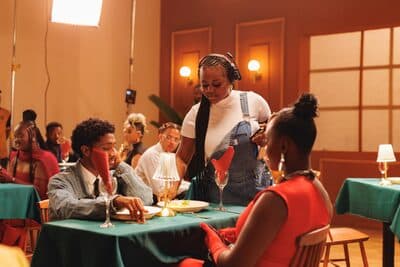
Back home, eating out [1]is automatic. In the US, the same twenty-minute meal comes with about fifteen small English moments you never studied in a textbook. "How many in your party?" "Still working on that?" None of them are hard, but if you're not ready, each one can throw you off [2].
Once you know the flow, it stops being intimidating [3]. Let's walk through one full dinner.
Arriving
- Hostess: Good evening! Do you have a reservation?
- You: Yes, under Kim, for two at seven.
- Hostess: Perfect, let me check you in.
Watch out: If you don't have a reservation, say "No, we're a walk-in" or "No, just two of us, is there a wait?" "Walk-in" is the standard word for "no reservation." When giving your last name, speak slowly and clearly. Hostesses hear hundreds of names a night, so slower is better than complete.
At the door
- Hostess: How many in your party?
- You: Two, please.
- Hostess: Booth or table?
- You: A booth, if you have one.
Watch out: "Party" means "your group," not a celebration. And always wait to be seated, even at casual places.
Ordering
- Server: Hi, I'm Jake. Can I start you off with something to drink?
- You: Just water, thanks. Still water, no ice.
- Server: You got it. Do you need a minute with the menu?
- You: Yes, please.
Watch out: "Water" often comes with ice by default, and sometimes sparkling. Say "still water, no ice" if that's what you want.
During the meal
- Server: How's everything tasting?
- You: Really good, thank you.
- Server: Are you still working on that, or can I take it?
- You: I'm all done, thanks.
Watch out: "Still working on that?" just means "are you still eating?" Answer with "I'm all done" or "Still working on it."
Paying
- Server: Anything else? Dessert, coffee?
- You: Just the check, please.
- Server: Sure. All on one, or separate checks?
- You: All on one, please.
Watch out: After you hand over your card, the server returns two receipts, one marked "Customer Copy" and one marked "Merchant Copy." Write the tip and total on the Merchant Copy, sign it, and leave it on the table. The Customer Copy is yours. In Korea you only sign once, so this is where many newcomers get confused.
[Cultural Notes]
Tipping is expected.
- 15% to 20% of the pre-tax total is standard for sit-down restaurants. Servers depend on tips for most of their income. Anything below 15% signals dissatisfaction.
"How are you doing?" ≠ "How are you?"
- Mid-meal, this usually means "How is your food?" A quick "Great, thanks!" is always right.
"Have a good one!"
- This casual American farewell is used everywhere. Just reply with "You too!"