
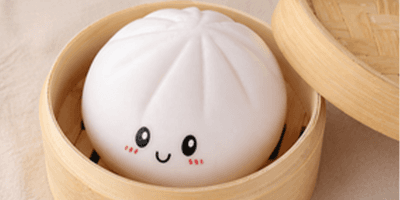
One of the hottest toys in America right now is a steamed dumpling. Not a real one — a palm-sized foam version that collapses under your fingers and rises slowly back into shape. Driven by TikTok ASMR videos, it has become one of the most viral [1] stress-relief toys in the US, sold blind-box style inside miniature bamboo steamers, so you never know which one you'll get. The appeal is not how it looks. It's how it feels. That slow, yielding [2], almost chewy resistance that makes it nearly impossible to put down.
And America is late to this party. In the UK, Jellycat's huggable plush animals brought in £333 million in 2024, up 66%, with profits more than doubling. In Korea, the brand's biggest buyers are no longer parents but adult collectors — a shift K-pop stars set in motion years ago by clipping plushies to their bags. And Japan arguably started it all, with an iyashi (healing) culture that normalized adult plush companionship [3] decades ago. Squeezed, hugged, or dangled from a handbag, the product is the same: sensation.
The buyers, notably, are not children. In the first quarter of 2025 alone, American adults spent $1.8 billion on toys, the highest of any age group. Adults now account for roughly 30% of global toy spending, a market worth over $12 billion a year.
Psychology explained this long before TikTok did. In the 1950s, Donald Winnicott coined the term "transitional object" for the blanket a toddler clings to while learning to feel safe apart from mother. A 2014 study extended the idea to adults: comfort objects lower anxiety and restore calm under stress and loneliness. Hugging something soft even releases oxytocin, the bonding hormone. In other words, the mechanism has been there all along. Adults simply stopped admitting they used it. In one survey, 60% of Gen Z respondents said plush toys relieve stress better than socializing does.
Seen that way, the dumpling craze looks less strange. Most of us already own one — the hoodie we won't throw away, the stress ball in the desk drawer, the cushion corner we knead [4] without noticing. We just don't call them toys.
What's yours, and when did you last let yourself squeeze it?