
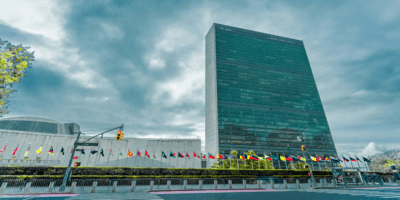
When most people think of the United Nations, certain images come to mind: the blue flag, the New York headquarters, peacekeepers in pale helmets, aid workers delivering food after disasters. The UN is widely seen as the world's main place for international cooperation, even if [1]an imperfect one. Experts have always been more critical, pointing to Security Council vetoes [2]and slow bureaucracy. But for decades, the question was how to fix the UN, not whether it would survive. That changed in January.
Secretary-General António Guterres sent member states a letter warning of "imminent financial collapse [3] ." The UN, he wrote, was caught in a "Kafkaesque cycle" — forced to refund money it had never received. The word comes from the novelist Franz Kafka, whose characters are trapped in strange bureaucratic systems [4]they cannot understand or escape. The UN's situation fits the term.
Under rules written in 1945, when a country is assigned [5]its yearly contribution, the amount is recorded as “paid”, even if no money has arrived. At the end of the year, any unspent budget must be returned to member states as “credit” toward next year's bill. The original idea was that all members would pay on time, and unspent funds would be real surpluses [6]. Today, the UN has to "return" money it never received, including to the countries that did not pay.
By spring, the 2026 budget had been cut by 15 per cent to $3.45 billion. Unpaid contributions had grown to more than $2 billion, most of it owed by a small number of major contributors. The problem was serious — but the rules themselves were making it worse. Guterres has asked member states to change the rule, but reform needs the agreement of those same major contributors. And the current rule actually works in their favour [7]: countries that withhold their dues [8] still get credits in the next budget. In other words, the system quietly rewards non-payment, and the countries that benefit most are also the ones whose agreement is needed to change it. The result is a slow, quiet deadlock [9].
The UN case is dramatic, but the pattern itself is common. Rules are written for the world the designer expects to continue. When that world changes, the rules often no longer fit. A company sets sales targets based on steady demand, and then loses its best people when the market collapses and the targets become impossible. A government builds a pension system on the idea that the population will keep growing, and decades later cannot pay what it promised.
The problem is not that rules are bad. It is that they were built for a world that no longer exists. The policies that survive are the ones that asked, from the beginning, what they would look like when their assumptions stopped holding.
Editor's Note:
On June 30, 2026, the UN General Assembly approved a new rule, which started on July 1, 2026. Under this four-year test plan, the UN will return extra money to member countries only if it has actually received the cash. This simple change stops the UN from returning money it never got.