
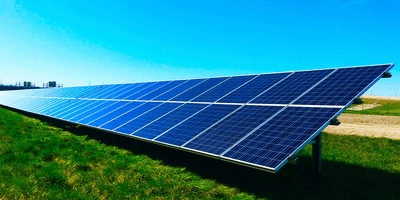
When the Strait of Hormuz was effectively closed this year, cutting off a fifth of the world's oil, the countries most exposed did something telling. They did not just scramble for other oil suppliers. They placed orders for Chinese solar panels. In the first month alone, China shipped out 68 gigawatts of solar capacity, enough to power all of the United Kingdom for a night. Exports to India nearly doubled; those to Africa jumped fivefold. When the world needs energy that does not depend on a tanker crossing a war zone, it turns, almost reflexively, to China.
That reflex was built deliberately, over twenty years. In 2004, Chinese-owned firms made less than 2% of the world's solar cells. By 2024, they made more than 80%, and at the deepest layers of the supply chain the figures are starker still: roughly 93% of the world's polysilicon and 97% of its wafers. At every stage, from raw material to finished panel, China holds a share that would draw antitrust scrutiny [1] in any normal market.
How did this happen? The answer is a self-reinforcing [2] cycle that competitors have found almost impossible to break. Government policy, beginning around 2009, poured subsidies into the industry, more than $50 billion between 2011 and 2023 alone. That funding enabled enormous scale. Scale pulled every part of the supply chain into one country, which drove costs below what anyone abroad could match. Lower costs, in turn, financed research: by 2024 China held 65% of the world's solar patents [3]. Each layer reinforced the next, and the flywheel spun faster every year.
The benefits for the planet are real. Cheap Chinese panels have made solar power the least expensive electricity in history and accelerated the shift away from fossil fuels worldwide. Yet two shadows fall across the story. The first is a double grievance [4], about fairness and about dependence. Critics argue the dominance was not won on a level field but bought, with state subsidies and a protected home market that let Chinese firms undercut everyone else. The result is that rival industries have collapsed from the United States to Europe to South Korea, and that every nation's energy future now runs partly through Beijing. The backlash [5] has been fierce: the United States has thrown up tariffs reaching, in some cases, into the thousands of percent, the European Union has tried its own duties, and governments far beyond them are scrambling to rebuild what little domestic capacity they have left.
The second is stranger. Despite shipping record volumes, China's own solar giants are losing money, the 22 largest firms together lost $1.5 billion in early 2026, as prices collapsed under their own overcapacity.
So it is hard to say China simply won the solar race. Having built a machine so vast, it now lights the world's rooftops while draining its own factories, straining to wring a profit from its own creation. And it leaves the rest of the world an uneasy bargain. Cheaper, faster decarbonization is on offer, but the price is that the technology the planet needs most sits in a single country's hands, won by rules few others would play by.
Every government now faces the same question. Pay more to rebuild an industry from the ruins, or accept that the road to a greener future runs through Beijing? The sun is easy to capture and hard to hold. The harder problem is no longer who makes the most panels. It is whether a clean-energy future can rest in one country's hands. That question is only beginning.