
On May 17, 2026, the World Health Organization declared the Ebola outbreak in the Democratic Republic of Congo (DRC) and Uganda a Public Health Emergency of International Concern (PHEIC) — its highest level of alarm, reserved for events requiring a coordinated international response. It is not a pandemic declaration [1]. The WHO explicitly [2] stated this outbreak does not meet the criteria of a "pandemic emergency" — a higher classification under the amended International Health Regulations — and currently assesses the risk as high at the national and regional levels, but low at the global level.
Even so, the way the PHEIC was declared signals deeper concern. Director-General Tedros Adhanom Ghebreyesus issued it before convening the Emergency Committee — the first time a WHO chief has done so. He has said he is "deeply concerned about the scale and speed of the epidemic," pointing to cases in urban areas, the deaths of healthcare workers, and significant population movement in a region of active conflict. Experts added a fourth concern: the virus spread undetected for weeks because initial tests targeted the more common Zaire strain of Ebola and returned negative.
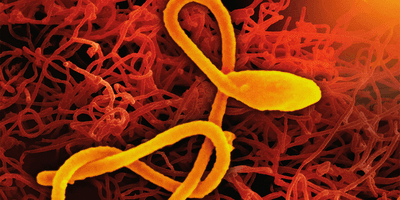
Three Ebola strains cause large human outbreaks [3] — Zaire, Sudan, and Bundibugyo. Zaire has killed up to 90 percent of those infected; Bundibugyo, the strain behind this outbreak, has historically killed 25 to 50 percent. None spread through the air. Transmission requires direct contact with the blood or bodily fluids of someone visibly ill or recently deceased, meaning, in principle, the disease is controllable, provided the response moves faster than the virus. Bundibugyo was identified only in 2007, and until now there had been just two prior outbreaks totaling roughly 211 cases. The current outbreak with 600 suspected cases by May 20, however, is already larger than the previous two combined. There is no approved vaccine or treatment; what works is early intensive supportive care.
Countries far from the epicenter [4] face a low risk of community transmission but a real risk of imported cases. The United States has imposed its first-ever Ebola-related travel ban, restricting non-U.S. passport holders who have been in DRC, Uganda, or South Sudan in the past 21 days, and routing returning Americans through a single airport for screening. The EU has declined to recommend airport entry screening, opting instead for traveler tracing protocols.
The response system itself is weaker than it was a year ago. Between 2019 and 2022, roughly 45 percent of all global health spending came from the United States, historically the WHO's largest single donor at about 18 percent of its budget. In January 2025, the Trump administration announced U.S. withdrawal from the WHO, effective January 2026. In March, it moved to eliminate 83 percent of the programs run by USAID, the U.S. Agency for International Development that has historically led American humanitarian and global health work abroad. The WHO now faces a $1.9 billion shortfall, roughly 45 percent under-funded for 2026-27.
Other actors have moved to fill the gap, but only partially. Within days of the PHEIC, the European Commission committed €15 million in humanitarian assistance and organized a EU-UNICEF airlift of nearly 100 tonnes of supplies to eastern DRC. The WHO released $3.9 million from its emergency contingency [5] fund. Médecins Sans Frontières deployed teams on the ground. Even the U.S. State Department mobilized $23 million in bilateral assistance and announced funding for up to 50 treatment clinics. But aid workers on the ground have been blunt: years of cuts to USAID, the CDC, and WHO contributions have already eroded the surveillance, laboratory, and logistics capacity that contained earlier outbreaks. The pieces remain; the architecture that held them together does not.
After COVID-19, many governments concluded that the world needed a stronger global health architecture, not a weaker one. Mechanisms like the Pandemic Fund — to which Korea, Japan, the EU, and others continue to contribute — were built precisely for this kind of moment. But no coalition has yet matched the scale or coordinating role that the United States once played, and the 2026 outbreak is the first major test of whether a more distributed model can move fast enough.
Whether this outbreak is contained quickly or not, the lasting question is whether the international health system, as currently constituted, can still pass a test like this — and if it cannot, which countries are prepared to help rebuild it before the next one arrives.