
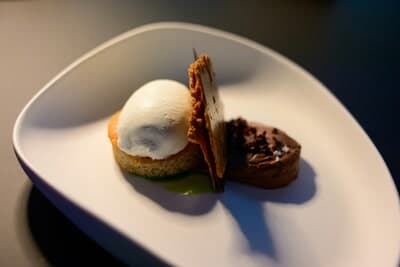
Despite its somewhat antiquated facade, Paris has a dynamic culinary scene that has revolutionized over the years while preserving traditional elements of French cuisine.
France is the birthplace of many things with respect to food and cooking, including sauces, restaurants, and the Michelin guide. Most American cooking schools offer curricula based on French cuisine, without English equivalents of the countless French terms that students have to learn. French cheeses and wines continue to carry on their reputation as the world’s best, and, arguably, the Michelin guide is still the most authoritative [1] list of restaurants.
Up until the 18th century, the concept of a modern restaurant with a menu and table service didn't exist. Before the French Revolution, taverns and inns were the only places to eat out, and these places typically had a single menu item with changing prices and served at certain hours during the day. Around 1765, the first "restaurant" popped up in Paris. Opened by a Parisian named Boulanger, this place sold mostly bouillons restaurants, meaning “restorative [2] broths.” Therefore, the term restaurant was initially associated with therapeutic effects, as the French verb restaurer means “to restore oneself.”
Also called “health houses,” these bouillon restaurants took off. As these establishments spread and diversified, other items started to show up on the menu, such as eggs, stewed chicken, and semolina cakes—their light color was believed to have health benefits.
By the 1780s, these "health shops" had loosely evolved into the kind of restaurants that we see today and established a prototype for fine dining in the following centuries. They served food without a fixed schedule and provided a printed menu on every table. The 1789 Revolution expanded the cuisine even further, as it abolished the guild system and allowed anyone to produce and sell food they wanted.
With a wide range of menu items and great service available, eating was no longer just for health–the culturally predominant purpose of eating was now pleasure. Fancy eating was no longer limited to the royals and nobles with personal cooks, and the restaurant industry started blooming.
As more chefs honed their culinary techniques and showed off delicious foods at their restaurants, the French cuisine became more and more refined, with long course meals, exquisite ingredients, and wines. In the 19th century, Auguste Escoffier, one of the most critically acclaimed [3] chefs in the history of cooking, invented several systems to streamline professional kitchens.
A major accomplishment of his is defining the five French mother sauces, which would spawn countless variations that complement a wide range of dishes from salads to steak to dessert, even to this day. He also created “kitchen brigade,” a system of hierarchy that delegates responsibilities to kitchen staff members, specializing in certain menu items and corresponding tasks. One of the major positions of his system was that of sous chef, meaning “top assistant chef,” which is still commonly found in any fine dining kitchen.
With its sophisticated systems and recipes, French cuisine long enjoyed the reputation of being the world’s finest, well into the 20th century. Yet, other European and American cities saw rapid developments in their restaurant industries, and some French chefs, who grew tired of buttery sauces and exceedingly intricate [4] recipes, left Paris and its old traditions to explore more creative cookery.
Then, there was the “Judgment of Paris” in 1976, a blind wine tasting in Paris where California wines rated first for both white and red categories. This result shocked France and the rest of the world, since French wine had been regarded as the best in general, along with their food. It was also a wake up call for the French to revisit their traditions, which could sometimes work against necessary changes and progression.
It was time for some change in the kitchen as well. Although the term had previously been used several times to describe fresh ideas of cooking, Nouvelle Cuisine, meaning “new cuisine,” now had definitive standards, set by a couple of French food journalists. It was characterized by a rejection of excessive complication and a pursuit [5] of shorter cooking times, simpler menus, and lighter sauces. In the 1970s, many elite chefs in France joined the movement and abandoned the weight of the classical French cuisine.
The famous Michelin guide has awarded stars to restaurants in France since 1926, and Paris finally got its own publication in 2012 that introduced 77 starred restaurants. The number bumped up to 119 in 2020, and it was not just the quantity of great restaurants that increased, but also the diversity of the cuisine that got pushed forward.
In the 21st century, the city has seen a number of exciting culinary ideas as some chefs explore completely plant-based recipes and others fuse different cultural elements with the French classics. However, more chefs are returning to their traditions than ever, pursuing the roots of the delicious flavors of France. Many are updating the old classics like French onion soup and veal stew with quality ingredients and time-consuming techniques, with contemporary twists. Going through yet another French revolution, Paris continues to lead the world’s culinary industry as it successfully strikes the balance between the old and the new.