
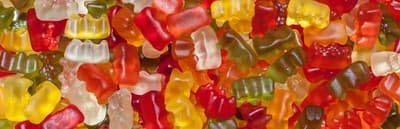
In 1920, German confectioner [1] Hans Riegel Sr. established a candy company called Haribo, an abbreviation of Hans Riegel Bonn, his name and hometown of Bonn. Riegel set off to create a new sweet treat in his kitchen and hired his first employee, his wife, Gertrud. In 1922, Riegel debuted his first gummy prototype, dubbed Tanzbären, or the Dancing Bear in German. Larger than modern gummy bears, their shape was inspired by real dancing bears that were once prevalent in festivals across Europe.
In Riegel’s lifetime, Haribo went through steady growth, only interrupted by a hiatus [2] caused by World War II. They almost closed down the production after the war, and the several hundred employees they once had dwindled [3] to about thirty. However, the next generation of Riegels, Paul and Hans Reigel Jr., took over their father’s business in 1946 and turned Haribo into a global superpower. With Paul overseeing production and Hans Jr. in charge of marketing and sales, the brothers upped the number of employees to about 1,000 in 1950. Haribo grew in the 1950s and 60s, capitalizing on new marketing tools, including television.
Throughout Haribo’s history, the gummy bears went through multiple makeovers, including the most prominent transformation in the 1960s when they were rebranded as Goldbears. Today, these chewy bears come in five flavors (raspberry, lemon, strawberry, pineapple, and orange) and are available in more than 100 countries.
Though Haribo was Riegel’s invention, he was not the first to create gelatin-based sweets. Beth Kimmerle, a writer of four books documenting America’s confectionery industry, said the gummy bear formula came from gelatinous precursors such as the Turkish Delight. Susan Benjamin, a candy historian, believes that Riegal’s gummy bears were a fine-tuned version of an already existing candy formula. The truly innovative part about the Haribo bear, then, is its shape. Riegel’s business acumen played a role, too, as he was quick to take the latest confectionery technologies, flavors, and colors, and apply them to the bears.
Another element of Haribo’s success is its consistent quality and marketing. “They’ve really been able to maintain that position in the marketplace,” said Kimmerle. This endurance in the market is an asset in and of itself since it has a self-sustaining [4] quality; Haribo has stayed in the market long enough to have become a nostalgic memory for consumers who grew up with it, and as long as these people live, the product will continue to stay relevant.