
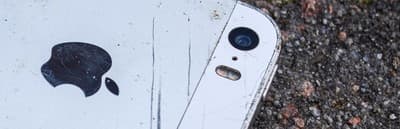
One of the first things that many people do after getting a new phone is investing in its protection. For some, this means a case and a nice screen protector. After all, one might think that a phone with a giant screen being carried around in a pocket or purse with keys, coins, and other sharp objects would be bound to get scratches, right? While it’s true that a new phone will eventually get scratched, it turns out that it’s not the keys or coins that are doing the scratching.
To better understand scratching, one must first understand the hardness of materials. Introduced in 1812, Mohs scale of mineral hardness allows for the quantification of most minerals. The scale runs upwards, with talc being 1 (softer than diamond) and diamond being 10. Softer materials cannot scratch harder materials, but harder materials can scratch softer materials. While household keys run around a 4 on the scale, copper coins are a 3.
Glass, the material that most phones are made out of, are usually a 5 on Mohs scale of hardness, meaning they’re not susceptible [1] to scratches from coins and keys. Moreover, many modern smartphones (especially flagship [2] ones) use patented technologies that harden the glass, making them reach level 6 or higher on the Mohs scale of hardness.
Sapphire, a material that is sometimes used for screens, ranks 9 on the Mohs scale of hardness. You might be wondering: why don’t smartphone manufacturers use sapphire displays more often? The reason is that although sapphire is far more scratch resistant [3], it’s also much more brittle, meaning that it’s susceptible to breakage on hard impacts. In addition, sapphire is far more expensive than glass, making the tradeoff a difficult one to justify.
Most screen protectors, though, even the glass ones, tend to be far weaker than the glass in a phone. Not only does that mean they tend to break or scratch more easily than the phone screen, but protectors can also be difficult to apply, leading to small pockets of air or dust trapped beneath them. At the end of the day, the decision on whether or not to use protection for a new phone is a personal one.