
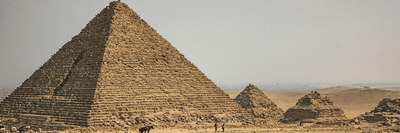
The pyramids are one of the greatest architectural achievements of all time and a symbol of Egypt’s enduring legacy. While pyramid-shaped structures exist in other parts of the world—such as ancient China, Mesopotamia, and Central Africa—the Pyramids of Giza are the most renowned due to their massive scale and historical significance.
The ancient Egyptians constructed over 300 pyramids along the Nile River over the course of 3,000 years. Among them, the three Pyramids of Giza stand out as monumental wonders. The tallest, the Great Pyramid, soars to a height of about 140 meters, surpassing landmarks like the Statue of Liberty, the Leaning Tower of Pisa, and Big Ben. Remarkably, these colossal structures were built around 2550 BCE—over 4,500 years ago!

The scale of the task is mind-boggling [1]. Each stone block used in the pyramids weighs an average of 2.5 tons. Without modern machinery, these blocks had to be pushed, pulled, and dragged by human effort. The Great Pyramid alone is estimated to contain 2.3 million blocks, with a total weight of 6 million tons. This led some to speculate [2] that the pyramids were built with the help of extraterrestrial [3] beings!
However, no aliens were involved in their construction. Instead, the ancient Egyptians harnessed [4] natural forces and innovative techniques. For years, the method they used to transport the massive stones remained a mystery, but recent scientific discoveries have provided new insights.
Researchers found evidence that the ancient Egyptians used a now-vanished branch of the Nile River to move the stone blocks closer to the construction site. This ancient waterway, once much nearer to the pyramids than the current Nile, allowed the stones to be transported by boat.

Once the stones arrived, the Egyptians likely built massive sand ramps to haul the blocks up to the pyramid’s height. But pulling a 2.5-ton block up a sandy hill would have been incredibly challenging. To overcome this, scientists believe the Egyptians wetted the sand, increasing its stiffness and reducing friction [5], making it easier to pull the stones uphill.
These discoveries highlight the ingenuity [6] and resourcefulness of ancient Egyptians. Building the Giza Pyramids without modern technology was an extraordinary feat, demonstrating the brilliance of this ancient civilization.