
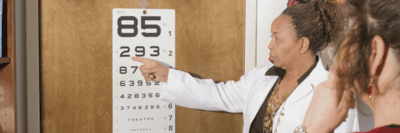
Do you wear glasses? Fun fact: it seems like about 62% of the world’s population requires eyeglasses for some form of visual correction. If you find yourself needing to visit an optometrist for a new prescription [1] or for an ailment [2] of the eye, check out some expressions we’ve prepared for you, below.
* In English, the field of eye care is divided into the following three specialties:
- optometrist: A doctor who tests eyesight and checks for diseases.
- ophthalmologist: A doctor who treats eye diseases.
- optician: A professional who selects and fits eyeglasses, contacts, etc.
Describing Visual Acuity Issues
“I can’t seem to see things clearly when they’re close up.”
“I can’t see things far away.”
- The above two descriptions can help your eye doctor to determine the nature of your vision issue.
“Everything in my periphery seems a bit blurry.”
- One part of your vision, peripheral [3] vision, is the component of sight for things you’re not actively focused on.
“I have trouble seeing at night.”
- Again, if you’re having vision issues under specific circumstances, the above phrase may be helpful.
Describing Discomfort of the Eye
“I’m pretty sensitive to light.”
- If you’re having trouble keeping your eyes open in bright environments, you might say the above to your provider.
“My eyes feel dry and scratchy [4], especially in the mornings.”
- It can be useful to be able to describe sensations in your eye to your provider. Context is key!
“It feels like there’s something in my eye.”
- A “foreign body sensation,” as medical professionals call it, is the sense that there’s dirt or dust or something foreign in the eye(s).
Asking for Clarity
As part of a routine eye exam, an eye care professional may ask you to report which one of two images is clearer.
“I see the first image a bit more clearly.”
“I’m sorry, could you show me both of them one more time?”
- If you need another look to decide which image is clearer, don’t hesitate to ask your provider!
Many terms that may be used by medical professionals don’t necessarily reflect the way the average person speaks. Our goal for this series is to give foundational expressions that are understood by the layperson while allowing for communicating with medical professionals in the English language. We’d love to get your feedback, both good and bad, on our series.