
Chick-fil-A America’s beloved chicken sandwich Chick-fil-A is an American fast-food chain specializing in chicken sandwiches and has come a long way since founder Truett Cathy developed the boneless chicken sandwich recipe in the 1960s. In 2019, Chick-fil-A was the third largest chain in the US, after McDonald’s and Starbucks, and the company routinely ranks high in customer satisfaction surveys. Unlike other typical fast-food restaurants that lure [1] customers in with new menu items, Chick-fil-A has stuck to its chicken sandwich, now considered a fast-food classic, and built its reputation on a conservative growth model that prioritizes quality control. What is noticeable about Chick-fil-A is that, despite having 2,600 restaurants throughout the country, it remains a private company. According to CEO Andrew Cathy, the company has grown conservatively and doesn’t need the extra cash from outside investors to scale its operations. This slow and controlled approach to growth is their differentiator and is reflected in their franchising model, where Chick-fil-A selects, builds, and owns every one of its locations, unlike most fast-food chains, where the franchisee covers most of the cost of opening the restaurant. On its official website, the company states, “franchising is not an opportunity for passive financial investment, working from the sidelines, or adding to a portfolio of business ventures.” Each franchisee, called an operator, is handpicked by Chick-fil-A through a rigorous [2] interview process. The company credits its hands-on [3] approach with the success of its restaurants, which generate far more revenue per location than other fast-food chains. In 2021, Chick-fil-A restaurant generated $5 billion in sales, compared with $2.9 billion from McDonald's and $2.2 billion from Chipotle. However, Chick-fil-A’s success hasn't been without its controversy. The company prides itself on its Jeudeo-Christian roots, and attracted attention from progressive groups when its foundation donated to groups perceived as anti-LGBTQ+. This was a PR nightmare, given the open and inclusive stance endorsed [4] by many large American corporations in recent years. According to the Chick-fil-A foundation website, the company promises to give to three different areas, focusing on education, homelessness, and hunger. When asked to comment on this issue, CEO Andrew Cathy told the Wall Street Journal, “I think the most important thing for us being in the restaurant business is to serve everybody. My grandfather, I love how he talked about it with politics. He would say, ‘I’m not left wing or right wing, I’m the whole chicken.’” His response might have been evasive, yet a tactful [5] one. Discussion Questions Q1 In your own words, please briefly summarize the article. Q2 What part of the reading resonated with you most? Q3 What makes Chick-fil-A stand out from other fast-food chains? Q4 What do you think are the benefits and drawbacks of Chick-fil-A's conservative growth model? Q5 What is your opinion on the statement from Chick-fil-A's website that franchising is not an opportunity for passive financial investment? Do you agree or disagree? Q6 Does a company's social and political stances influence your decision to support them as a consumer? Explain. Q7 Do you think Chick-fil-A's model of controlled growth and emphasis on quality over quantity is sustainable in the long term? Q8 If you have a question or questions that you'd like to discuss during your class, please write them down. Expressions lure tempt 例文 1 The bright colors were luring for the younger children. 例文 2 He was luring me to have the cake. rigorous thorough and accurate; strict and demanding; harsh or severe 例文 1 She underwent rigorous training to prepare for the Olympic competition. 例文 2 The rigorous testing process ensures the product's quality and safety. hands-on by real-life experience compared to reading or hearing about it 例文 1 Getting some hands-on experience as an intern is important when you want to choose your future career. 例文 2 He is a very hands-on manager: the reason her team members love him. endorse publicly declare one’s approval 例文 1 This vitamin supplement has been endorsed by many celebrity figures. 例文 2 The company endorses and encourages such behaviors. tactful showing sensitivity and skill in dealing with difficult situations or people 例文 1 He gave a tactful response to the critical question, avoiding offense while getting his point across. 例文 2 Her tactful handling of the disagreement helped maintain a positive atmosphere during the meeting. |
| *本教材は、Ringleを使用して英語を学ぶ学習者向けに設計されています。 |
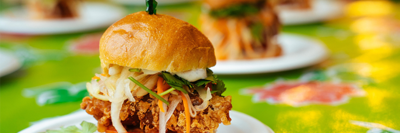
Chick-fil-A is an American fast-food chain specializing in chicken sandwiches and has come a long way since founder Truett Cathy developed the boneless chicken sandwich recipe in the 1960s. In 2019, Chick-fil-A was the third largest chain in the US, after McDonald’s and Starbucks, and the company routinely ranks high in customer satisfaction surveys. Unlike other typical fast-food restaurants that lure [1] customers in with new menu items, Chick-fil-A has stuck to its chicken sandwich, now considered a fast-food classic, and built its reputation on a conservative growth model that prioritizes quality control.
What is noticeable about Chick-fil-A is that, despite having 2,600 restaurants throughout the country, it remains a private company. According to CEO Andrew Cathy, the company has grown conservatively and doesn’t need the extra cash from outside investors to scale its operations. This slow and controlled approach to growth is their differentiator and is reflected in their franchising model, where Chick-fil-A selects, builds, and owns every one of its locations, unlike most fast-food chains, where the franchisee covers most of the cost of opening the restaurant.
On its official website, the company states, “franchising is not an opportunity for passive financial investment, working from the sidelines, or adding to a portfolio of business ventures.” Each franchisee, called an operator, is handpicked by Chick-fil-A through a rigorous [2] interview process. The company credits its hands-on [3] approach with the success of its restaurants, which generate far more revenue per location than other fast-food chains. In 2021, Chick-fil-A restaurant generated $5 billion in sales, compared with $2.9 billion from McDonald's and $2.2 billion from Chipotle.
However, Chick-fil-A’s success hasn't been without its controversy. The company prides itself on its Jeudeo-Christian roots, and attracted attention from progressive groups when its foundation donated to groups perceived as anti-LGBTQ+. This was a PR nightmare, given the open and inclusive stance endorsed [4] by many large American corporations in recent years. According to the Chick-fil-A foundation website, the company promises to give to three different areas, focusing on education, homelessness, and hunger. When asked to comment on this issue, CEO Andrew Cathy told the Wall Street Journal, “I think the most important thing for us being in the restaurant business is to serve everybody. My grandfather, I love how he talked about it with politics. He would say, ‘I’m not left wing or right wing, I’m the whole chicken.’” His response might have been evasive, yet a tactful [5] one.