
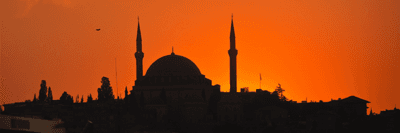
Until the evening of April 20, Muslims around the world will be observing Ramadan, the ninth month of the Islamic calendar, which began on March 22. According to Islam, it was during Ramadan when the prophet Muhammed received the first revelation [1] from the Qur’an, Islam’s holy book.
Ramadan is an annual observance [2] and one of the Five Pillars of Islam, or five obligatory acts of worship for all Muslims. It is a time of great spiritual significance, as Muslims refocus their relationships with God while abstaining from [3] eating and drinking from dawn until sunset every day. The fasting period is meant to help concentrate on prayer and reading the Qur’an, which is supposed to happen more frequently during the month.
At dawn, Muslims enjoy suhoor, the pre-fast meal, their only sustenance [4] until iftar at sunset. Over time, iftar has become a time for social gatherings, with traditional dishes sometimes being served buffet style. Some preparations of iftar feed hundreds or thousands of people; the Sheikh Zayed Grand Mosque in Abu Dhabi, the largest mosque in the United Arab Emirates, feeds some 30,000 people each night during Ramadan.
During Ramadan, the spiritual benefits, or thawāb, of fasting and other good deeds, such as charitable zakat, are believed to multiply. The month is truly a time for friends, families, and communities to come together to celebrate and renew their relationships with each other and God.
One of the odd-numbered days of the last 10 days of the month is Qadr Night, the holiest night during Ramadan (the exact date is uncertain). Then, Eid al-Fitr marks the end of Ramadan and its month-long fasting; it is celebrated with a prayer service and a feast.