
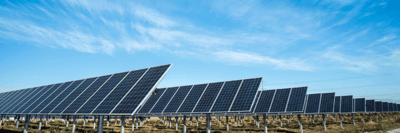
With a continuous push toward zero emissions, solar energy is becoming increasingly important. Reporting a 23% growth in new solar installations in 2020, the International Energy Agency (IEA) says solar energy “will continue to break records.”
Sustaining the solar boom are the many solar panels that cover the land and our rooftops. These panels, though, don’t last forever. Belying the phrase “clean energy,” after 25 years of converting sunlight to electricity, they become unwieldy electronic waste. The IEA projects that 7.8 million metric tons of solar panels will have reached the end of their life by 2050. This estimate doesn’t account for early replacement: the panels that are decommissioned before they turn 25 years old. New innovations are encouraging customers to replace existing solar panels for better models. And with early replacement factored in, 315,000 metric tons of e-waste will have been generated by 2050 according to Harvard Business Review. The solar e-waste glut [1] is coming.
To state the obvious, solar panel waste doesn’t dissolve easily and harmlessly like fallen leaves. These panels are basically an electronic sandwich: crystalline silicon cells are insulated on both sides with sheets of glass and polymers. Attached to the back of the panel is a junction box of copper wiring that transfers electricity as it’s being generated. Moreover, when solar panels enter landfills, the toxic materials they contain like lead can leak out and wreak environmental havoc.
Unfortunately, our system is woefully unprepared to handle the e-trash wave to come. Not only is recycling not mandated except in some European countries, but typical recycling methods simply won’t cut it [2]. Standard facilities treat e-waste crudely; they recover aluminum and copper from the panel’s junction box and frame and then shred the rest, creating impure, crushed glass. From a 60-cell panel, recyclers can recover $3 worth of materials, while the cost of recycling including transportation amounts to somewhere between $12 and $25. Dumping a panel in a landfill? It’ll cost you a buck.
In fact, there has never been a strong financial incentive to invest in recycling; at the same time, solar panels contain high amounts of cheap materials like glass and small amounts of high-value components– namely the silver and silicon. By extension, the long lifespan of solar panels has naturally discouraged the development of a circular model.
Thus, solar panel recycling solutions ought to be improved and supported by polities to ensure their widespread adoption. Finding technology to efficiently separate and purify valuable materials such as silicon and silver is a sensible approach. Some photovoltaic (PV) recyclers are already trying to do this. Veolia, a company that runs a commercial-scale PV recycling facility in France, grinds up solar panels and uses optical technology to recover low-purity silicon from the crushed resultant glass mixture. The company initially used other processes to recover silicon, but having introduced new equipment, it improved the efficiency of this recapture process. But developing an optimal circular model is a long shot. In a review paper published in July 2020, a team of researchers called for the development of a new method that will allow for the recovery of all minerals and metals from solar panels at high purity to ensure the sustainability and economic viability of PV recycling.
In addition to technological improvements, the solar recycling industry will need policy support to grow. Under the 2012 revision of the European Union waste legislation, producers of solar panels became responsible for collecting and recycling the modules. In the US, however, recycling is not mandatory– and only about 10% of modules are recycled. Awareness of the dark side of solar energy should spread for regulatory changes to happen. Sam Vanderhoof, the CEO of Recycle PV Solar, told Wired, “We need to face the fact that solar panels do fail over time, and there’s a lot of them out there.”