
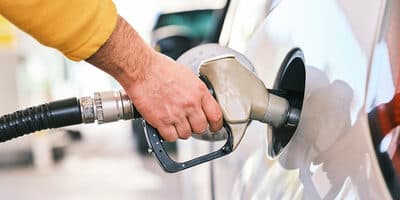
Pumping gas looks simple until you're actually there. An attendant walks up and asks, "How much you getting?" and you freeze. Do you say a dollar amount, a number of gallons, or "full tank [1]"? Then it's "What grade?" and you're staring at Regular, Plus, Premium, Diesel, not sure what you should be putting in, or what's actually best for your car.
So next time, you decide to try self-service. Safer, right? You pull up, insert your card, and the screen asks: "Enter your ZIP code." Your Korean card doesn't have one. You try guessing. It rejects. You try again. Same result. Finally the pump beeps: "See cashier." You sigh [2] and walk inside.
The good news? Once you know what to say, at the pump, at the counter, or to an attendant, the whole thing takes two minutes. Let's walk through all three.
Full-service pump
- Attendant: Hi, what'll it be?
- You: Fill it up [3] with regular, please.
- Attendant: Cash or credit?
- You: Credit.
- Attendant: Sure thing. Anything else? Windshield?
- You: No thanks, just the gas.
Watch out: To take the US as an example [4]: in New Jersey and parts of Oregon, self-service is banned, so attendants pump for you. Elsewhere, full-service is rare and pricier. "What'll it be?" means "What would you like?" A common reply: "Fill it up" or a dollar amount like "Twenty on regular." Tipping isn't expected, but $1~2 for extra help (oil check, windshield) is appreciated.
At the pump (self-service)
- Screen: Please insert or tap your card.
- Screen: Enter your ZIP code.
- You: (enter 5-digit ZIP)
- Screen: Select fuel grade. Regular, Plus, or Premium?
- You: (press Regular)
- Screen: Lift nozzle and begin fueling.
Watch out: Most US pumps ask for your ZIP code as a fraud check. Cards without a US ZIP (like Korean cards) will usually be rejected, which trips up many travelers and newcomers. The fix: pay inside with the cashier instead. Also, tapping your card at the pump may place a large temporary hold (sometimes $100~150). Don't worry, it clears in a few days.
Paying inside
- You: Hi, forty on pump seven, please.
- Cashier: Cash or card?
- You: Card.
- Cashier: Alright, you're good to go on pump seven.
- You: Thanks!
Watch out:Always name the pump number. "Forty on pump seven" means the pump stops at $40 or when your tank is full, whichever comes first. If your tank fills up at $32.50, cards are only charged the actual amount. But for cash, you have to go back inside for the change, or you lose it. To fill up all the way, say "Fill it up on pump seven" — cards get a temporary hold and are charged the exact amount after fueling.
[Cultural Notes]
In the US, prices are per gallon, not per liter.
- 1 gallon is about 3.78 liters. So $4 per gallon is roughly ₩1,400 per liter. American gas looks cheaper at first glance, but with bigger tanks and longer driving distances, monthly gas bills often end up higher than in Korea.
Prices vary a lot, even in the same city.
- US gas prices can vary by 50 cents to $1 per gallon within the same city. Freeway exits and airport-area stations tend to be the priciest. Costco, Sam's Club, and other warehouse-store gas stations are usually the cheapest, but you need a membership. Apps that show live gas prices near you (like GasBuddy) are widely used, and many locals check them before deciding where to fill up.
Which grade should you actually use?
- Most cars are designed for Regular (87 octane), and Plus or Premium doesn't make your car run better, cleaner, or last longer, despite what advertising sometimes suggests. Premium is only necessary if your car's manual requires it. If your manual says "recommended" rather than "required," Regular is still fine. Never pump diesel into a regular gas car, it's a serious and costly mistake.
Rewards and cashback add up.
- Many gas stations including Shell, Chevron, Exxon, BP have their own rewards apps that give 3~10 cents off per gallon. Grocery rewards apps like Kroger, Safeway, or Costco also offer gas discounts based on your grocery spending. If you drive a lot, these small discounts can save $10~30 a month.