
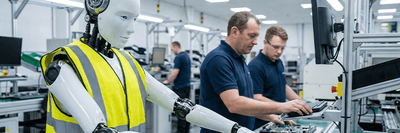
Humanoid robots[1] have moved decisively from science fiction to investment reality. What was once a long-term technological bet is now entering factories, balance sheets, and earnings calls. As manufacturers unveil concrete deployment[2] plans, the question for investors is no longer if robots will matter, but how soon they will reshape costs, productivity[3], and long-term growth.
That shift became clear at this year’s CES. NVIDIA, Tesla, and several major players showcased humanoid robot models, reinforcing the narrative that robotics is the next frontier of AI-driven growth. Hyundai, however, went further than most. Alongside Boston Dynamics, it didn’t just present technology—it laid out a commercialization roadmap. The company announced plans to deploy Atlas humanoid robots at its Georgia manufacturing plant starting in 2028, with a target production capacity of up to 30,000 robots annually and gradual expansion across global factories. For investors, this marked a critical inflection point: humanoid robots are no longer speculative R&D assets, but near-term capital investments with measurable returns.
Markets responded accordingly. Expectations of productivity gains, margin expansion, and new revenue streams helped lift related stock prices, reflecting confidence that industrial robotics could unlock the next phase of manufacturing-led growth. Automation[4] offers a compelling investment thesis: lower unit costs, more predictable output, and insulation from labor shortages in aging economies. In sectors like automotive manufacturing, even marginal efficiency improvements can translate into significant earnings leverage at scale.
Beyond company profits, supporters argue that automation can deliver broader economic benefits. Lower production costs may eventually reduce end-product prices, benefiting consumers. Robots also perform consistently in repetitive, hazardous, or physically demanding tasks, potentially reducing workplace accidents, insurance costs, and long-term liabilities—an underappreciated upside for both operators and shareholders.
Still, risks remain. Labor unions warn that large-scale robot adoption could trigger job displacement[5] and social backlash, raising political and regulatory uncertainty. Others point to skills polarization, where high-value engineering roles expand while mid-level manufacturing jobs decline. There are also unresolved questions around liability when automated systems fail and the capital intensity required to maintain advanced robotic fleets.
From an investment perspective, the key variable is execution. If productivity gains are paired with workforce transition strategies and shared value creation, robots could strengthen competitiveness and support sustainable growth. If not, cost savings may be offset by reputational risk, regulation, or social resistance.
So are robots on the factory floor a net positive for investors? Increasingly, markets seem to think so. But as automation accelerates, the real test will be whether today’s enthusiasm translates into durable earnings, and whether companies can turn technological promise into long-term value creation.