
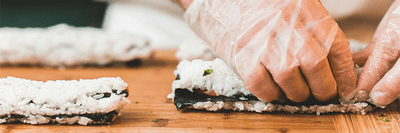
When asked about my love of sushi, I’m always a bit ashamed to admit that my favorite kinds of sushi are not the ones you find in Tokyo, not the fresh (albeit amazing) cuts of salmon nigiri or the classic oshizushi, but the ones that were, like me, born in America. The sushis that I fantasize about are the California rolls, wrapped up with avocados and cucumbers; the Philadelphia rolls, with their cream cheese; and the rolls that, although once recognizable, have since been battered and deep fried into an abomination [1] that can call no place home. Though, I suppose they call America home.
I have never been to Japan, nor do I have Japanese friends, and true fusion food is not without controversy. What Americanization does to cuisine is hard to articulate [2] (it’s easier to articulate what it does to a person), but I have no trouble imagining that the Japanese would cringe at the notion of an American dipping their roll into green-dyed horseradish (“wasabi”) mixed into soy sauce. It’s probably much like that BBC episode I watched during which a host fails to wash her rice, cooks it, and then goes on to dump the steaming, cooked rice into a colander [3] before “rinsing” it under cold water.
What does it take for a way of eating to garner [4] tolerance? In Japanese culture, sushi is considered an art form. Even I can understand that to call “sushi” this gelatinous ball of dough that resembles neither rice nor fish constitutes some form of blasphemy [5]. But, I wonder if my sushi might one day, like the humble banh mi, born from colonialism, grow to acceptance across the world. Can it, at the very least, grow into something more than that which inspired it? Although it may be an abomination now, I know that when I leave this country, it is perhaps one of the things I will miss most.