
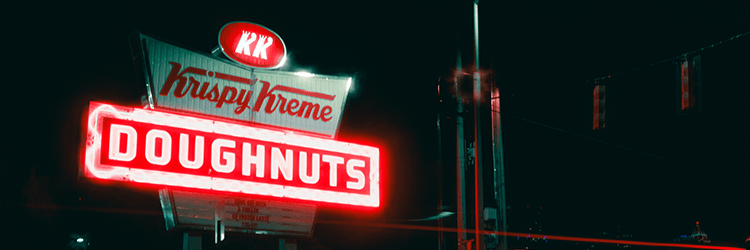
Glazed doughnuts can technically mean anything as long as they are coated in something. But original glazed means something, and something specific: Krispy Kreme’s iconic sugar-glazed doughnuts. Endorsed [1] by snackers and truckers alike, Krispy Kreme has reigned [2] supreme as the doughnut shop in many regions in and outside the US. The company was one of the first of its kind to foray into mass-produced donuts, and after over eighty years of operation, it continues to innovate its logistics and marketing approach.
Krispy Kreme was founded in 1937 by an entrepreneur named Vernon Rudolph when he bought a yeast-raised dough recipe from a French chef in New Orleans, rented a building in Old Salem, North Carolina, and began selling doughnuts to local grocery stores. Passersby, who smelled the frying doughnuts in the Old Salem bakery, began to ask if the doughnuts were available for purchase, and Rudolph cut a hole through the wall and started selling the original glazed directly to customers.
Throughout the 40s and the 50s, the chain of stores kept growing, most of them family-owned. But a major revolution with automation came around this time when Krispy Kreme built one of the first mix plants in food history to distribute dry doughnut mix to its outlets. Each location had been baking doughnuts from scratch, which had created inconsistent quality. The mix facility and Krispy Kreme’s proprietary [3] doughnut-making machines that followed enabled better quality control of their products.
Shortly after Rudolph passed away in 1973, his family sold Krispy Kreme to Beatrice Foods Company, and much of the original recipes and formulas were altered to cut costs before ownership changed hands again in 1982 to a group of franchisees. The company’s current owner is JAB Holding, a German investment firm that has Panera Bread and Peet’s Coffee in its portfolio.
Krispy Kreme currently has 373 shops in the US and over 1000 branded outlets internationally. Much of its success can be attributed to its distribution and marketing strategy. In an interview with CNBC, current CEO Michael Tattersfield attributed its growth even during the post-pandemic recession to its “omnichannel strategy” and “pricing power” based on seasonal products.
As part of its strategy to increase accessibility points, Krispy Kreme has recently entered into a partnership with McDonald’s. Starting October 26, the burger giant started selling Krispy Kreme doughnuts at nine locations in the Louisville, Kentucky area as part of a test: “The test comes as consumers have been cutting back on restaurant visits as soaring inflation pressures budgets,” according to CNBC. Doughnuts are not considered a necessity, so the company is certainly trying to lure in cash-strapped [4] customers. Any predictions on the consequences of this test would be premature.